


Topological Turning Points in Brain Development: Insights from Zebrafish and Humans

I often wonder why a nine-year-old's brain works so differently from a teenager's, or why cognitive changes seem to accelerate around retirement age? In my view, recent breakthroughs in neuroscience and data science are revealing that our brains don't develop gradually: instead, they undergo dramatic reorganization at specific "topological turning points" throughout our lives.
In my lab, we're fascinated by how these developmental patterns compare across species in comparative neurobiology, particularly between humans and zebrafish. While it might seem strange to compare our complex human brains to those of tiny fish, zebrafish have become invaluable models for understanding neurodevelopment and neural circuits. Their transparent embryos, rapid development, and surprising genetic similarity to humans make them perfect for studying the fundamental principles of brain organization.
The Discovery of Four Critical Turning Points in Human Brain Development
A recent study published in Nature Communications identified four major turning points in human brain development that fundamentally reshape how our neural circuits are organized. Using advanced data science techniques and graph theory analysis on over 4,200 participants from birth to 90 years old, the researchers discovered that our brains undergo massive structural reorganization at approximately ages 9, 32, 66, and 83.
These aren't just gradual changes: they're dramatic shifts in brain topology that divide our entire lifespan into five distinct developmental epochs. Each turning point represents a moment when the brain's network organization pivots in a completely new direction, affecting everything from sensory systems to higher cognitive functions.

Epoch 1: The Foundation Years (Birth to Age 9)
During the first nine years of life, human brains already show remarkably sophisticated organization. Even newborns display adult-like structural features including hub distribution, rich clubs, and small-world networks. This early sophistication suggests that fundamental brain architecture is established very early in neurodevelopment.
In our zebrafish research, we see similar early organization principles. Zebrafish larvae develop functional sensory systems within just days of fertilization, and their neural circuits show many of the same organizational principles found in mammalian brains. This comparative neurobiology approach helps us understand which aspects of brain organization are truly universal versus species-specific.
Epoch 2: The Great Reorganization (Age 9 to 32)
The transition at age nine aligns with puberty onset and marks the beginning of the most dramatic developmental period in the human brain. Between ages 9 and 32, brain networks become increasingly integrated and efficient, with white matter volume and integrity reaching their peak.
But here's what makes this epoch extraordinary to me: age 32 represents the "strongest topological turning point" across the entire human lifespan. At this precise age, five different topological metrics simultaneously reverse direction: global efficiency increases while characteristic path length, small-worldness, modularity, and betweenness centrality all shift course. It's like the brain executes a coordinated U-turn in its developmental trajectory.
I see profound implications for understanding psychology and cognitive development. The early thirties represent peak brain connectivity and efficiency, which aligns with research showing peak performance in many cognitive domains during this period.
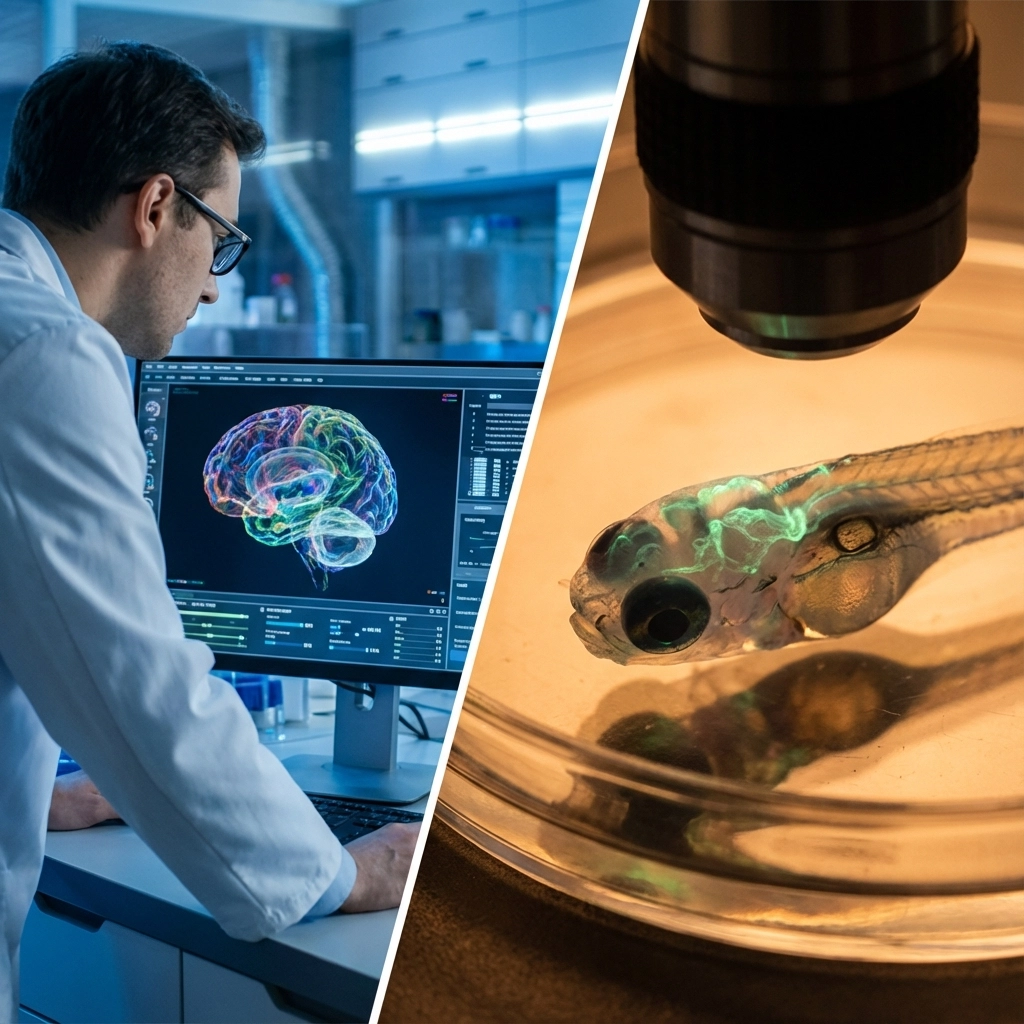
Zebrafish: A Window into Developmental Mechanisms
While humans take decades to reach developmental milestones, zebrafish compress similar processes into days or weeks. This acceleration makes them invaluable for studying the molecular mechanisms underlying these topological changes. In our lab, we can observe entire developmental programs unfold in real-time, something impossible with human subjects.
Zebrafish and humans share approximately 70% of their genes, and many of the key regulatory pathways controlling brain development are remarkably conserved—a core theme in evolutionary neuroscience. This evolutionary conservation means that discoveries in zebrafish often translate directly to understanding human neurodevelopment. When we identify genes or neural circuits controlling brain organization in zebrafish, we're often uncovering mechanisms that operate similarly in our own brains.
The transparency of zebrafish embryos also allows us to watch neural circuits form in living animals. Using advanced imaging techniques, we can track individual neurons as they extend connections, migrate to their final positions, and begin functioning. This level of detail is crucial for understanding how the topological properties measured in human brain scans actually arise at the cellular level.
Epochs 3-5: Stability, Decline, and Adaptation (Age 32 to 83+)
Following the major reorganization at age 32, I see the human brain enter a period of relative stability lasting until age 66. This represents the longest stable epoch in human brain development, corresponding to peak adult cognitive performance.
The turning point at age 66 aligns ominously with the typical onset of hypertension and dementia in developed countries. Brain networks begin showing increased modularity and decreased integration: essentially becoming more segregated and less efficient. This shift marks the transition from healthy aging to age-related cognitive decline.
The final turning point at age 83 represents the oldest portion of the lifespan studied, showing the least dramatic changes but still significant enough to constitute a distinct developmental epoch.

Stress, Sleep, and Environmental Factors in Brain Development
Our research explores how environmental factors in early stages of life influence these developmental trajectories. Stress and sleep patterns, for instance, can significantly impact brain development and may influence the timing or severity of topological turning points.
Zebrafish are excellent models for studying these environmental effects because we can precisely control their sleep and stress exposure while monitoring brain development. We've found that chronic stress during critical developmental windows can alter the normal progression of neural circuit formation, potentially shifting the timing of topological transitions.
I think this research has important implications for human health and psychological intervention. If environmental factors can influence when and how dramatically these turning points occur, then interventions during critical periods might optimize developmental trajectories.
Future Directions in Neurobiology
I find that understanding these developmental patterns has profound implications. The dramatic reorganization occurring between ages 9 and 32 suggests this period represents a critical window for interventions and development.
Our ongoing research combines neuroimaging studies with detailed bebavioral experiments to understand the molecular mechanisms underlying topological turning points. We're particularly interested in how genes controlling neurodevelopment influence the timing and magnitude of these transitions.
By comparing topological development across multiple species and environmental contexts, we're building a comprehensive picture of how brains optimize their organization for different cognitive and sensory demands.
The intersection of human brain development research with comparative neurobiology using model organisms like zebrafish represents one of the most promising approaches for understanding the fundamental principles governing brain organization. As we continue to uncover these developmental patterns, we move closer to understanding not just how brains develop, but how we might optimize that development for better cognitive health throughout the lifespan.
To learn more about my work on brain development, comparative neurobiology, and evolutionary neuroscience, visit our research page** and explore our** recent publications.


Comments